
Choosing Healthy Coping Skills
Breaking Unhealthy Coping Habits: Why They're So Hard to Change—and How Healing Begins
"The path to healing isn't about never stumbling. It's about learning to keep moving forward, one step at a time."
Life has a way of teaching us how to survive.
Sometimes those lessons become habits that serve us well. We learn to ask for help, to rest when we're tired, or to lean on people we trust.
Other times, our brains develop coping strategies that were necessary during difficult seasons but no longer serve us today. We may withdraw from loved ones, keep ourselves constantly busy, overthink every decision, numb our emotions with food or alcohol, or criticize ourselves relentlessly.
If you've ever wondered, "Why do I keep doing this even though I know it's hurting me?" you're asking an important question.
The answer usually isn't a lack of willpower.
More often, it's because your nervous system is trying to protect you.
The encouraging news is that what your brain has learned, it can also relearn.
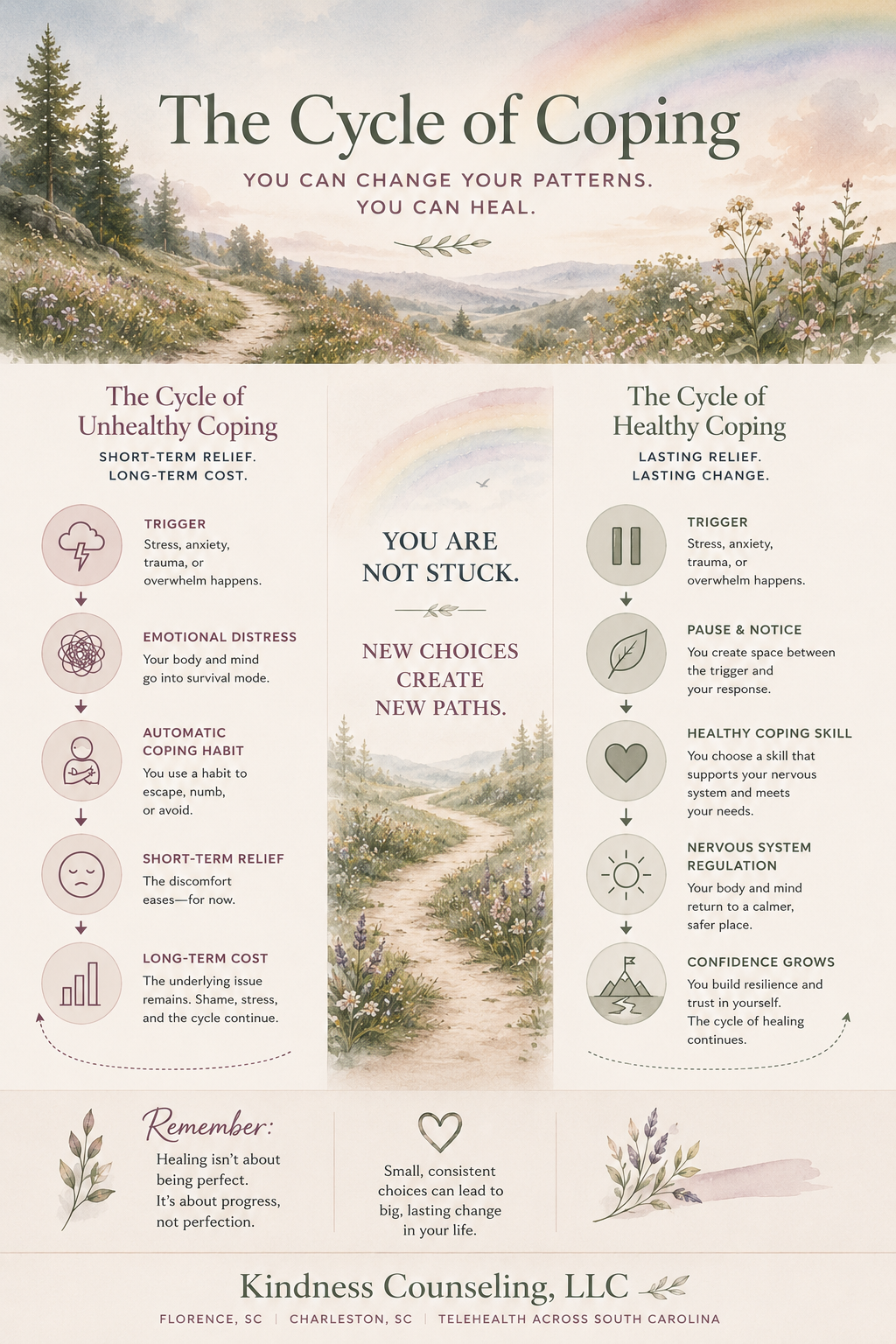
Common Unhealthy Coping Habits
People cope in many different ways.
Some of the most common include:
Withdrawing from friends and family
Avoiding difficult conversations
Emotional eating
Restricting food
Excessive scrolling on social media
Drinking alcohol or using substances to escape uncomfortable emotions
Staying constantly busy so there's no time to think
Sleeping far more than your body needs
Shopping impulsively
Perfectionism
People-pleasing
Harsh self-criticism
Procrastination fueled by anxiety
Trying to control everything around you
None of these behaviors develop because someone is "broken."
They develop because, at some point, they reduced distress.
Try These Healthy Coping Skills Instead
Healthy coping skills don't eliminate difficult emotions.
They help your nervous system move through them without becoming overwhelmed.
Some evidence-based strategies include:
Slow, diaphragmatic breathing
Long, slow exhalations activate your body’s natural relaxation response.
Grounding exercises
Notice five things you can see.
Four things you can touch.
Three things you can hear.
Two things you can smell.
One thing you can taste.
Grounding gently brings your attention back to the present moment.
Vagus nerve regulation
Practices such as humming, singing, slow breathing, and splashing cool water on your
face may help support nervous system regulation. While these techniques aren't cures,
they can be valuable tools for managing stress and anxiety.
Self-compassion
Many people believe being hard on themselves will motivate change.
Research consistently shows the opposite.
People who practice self-compassion are often more resilient, more motivated,
and more likely to recover from setbacks.
Treat yourself with the kindness you'd offer someone you love.
What Are Coping Skills?
Coping skills are the thoughts and behaviors we use to manage stress, emotional pain, uncertainty, and life's challenges.
Everyone has coping skills.
Some help us move toward healing.
Others help us survive the moment but leave us feeling stuck over time.
There is an important difference between coping and healing.
Coping reduces distress.
Healing changes the pattern.
Neither is wrong. In fact, many unhealthy coping habits began because they worked exactly as they were supposed to. They reduced emotional pain long enough for us to get through difficult experiences.
The problem is that our brains don't always realize the danger has passed.
Why Your Brain Keeps Choosing the Same Habits
Your brain is designed for one primary purpose:
Keep you alive.
It is constantly scanning your environment for signs of danger.
When it discovers something that temporarily reduces emotional pain—even for a few minutes—it remembers.
The next time you experience stress, your brain says,
"Last time this helped. Let's do it again."
Eventually that response becomes automatic.
This is why people often find themselves repeating behaviors they genuinely want to change.
Your brain isn't trying to sabotage you.
It's trying to protect you using an outdated instruction manual.
Why "Just Stop" Doesn't Work
If changing habits were simply a matter of determination, most people would succeed the first time they tried.
Real change is different.
Habits are stored in parts of the brain that love efficiency.
When stress increases, the brain automatically reaches for familiar responses.
This isn't failure.
It's neuroscience.
That's why shame rarely creates lasting change.
Curiosity does.
Instead of asking,
"What's wrong with me?"
try asking,
"What is this habit trying to do for me?"
That question changes everything.
Because once we understand the need beneath the habit, we can begin meeting that need in healthier ways.
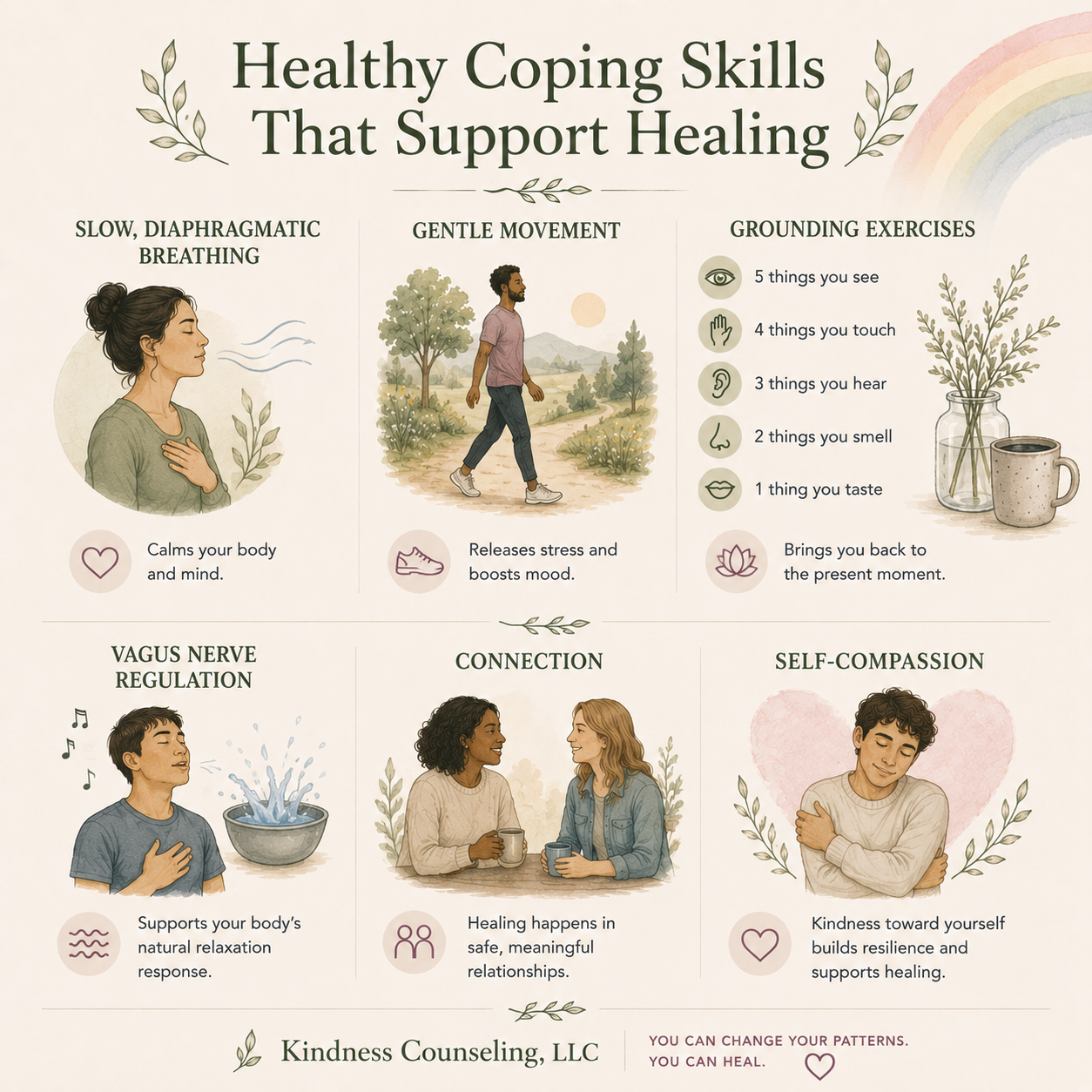
Connection
Stress often tells us to isolate.
Healing usually invites us to reconnect.
Even one meaningful conversation with someone you trust can help your nervous system feel safer.
Gentle movement
Walking, stretching, yoga, or simply spending time outside can reduce stress hormones and improve mood.
Healing Is Built One Small Choice at a Time
One deep breath won't change your life.
Neither will one walk.
Or one therapy session.
But hundreds of small choices?
Those can change everything.
Every time you pause before reacting...
Every time you choose honesty over avoidance...
Every time you ask for help instead of isolating...
Every time you speak to yourself with kindness instead of criticism...
You are teaching your brain a new path.
Those moments matter.
They are how healing happens.
How Therapy Helps Break Unhealthy Coping Habits
Sometimes unhealthy coping habits are connected to painful experiences that are difficult to process alone.
Therapy offers a safe, supportive space to understand where these patterns came from, identify what they're protecting, and develop healthier ways to respond to life's challenges.
At Kindness Counseling, LLC, we work with adults experiencing anxiety, trauma, depression, grief, relationship difficulties, and life transitions. We use evidence-based approaches—including EMDR, Cognitive Behavioral Therapy (CBT), mindfulness, and person-centered therapy—to help clients better understand themselves, regulate their nervous systems, and build healthier coping strategies.
We offer in-person counseling in Florence, SC and Charleston, SC, as well as secure telehealth services for adults throughout South Carolina.
Healing doesn't happen because someone tells you to "just stop."
It happens because someone helps you understand your story with compassion and gives you the tools to write a new chapter.
You Are Not Stuck
Your coping habits are not your identity.
They are learned patterns.
And learned patterns can change.
No matter how long you've struggled with anxiety, trauma, or unhealthy coping habits, your brain remains capable of growth. Your nervous system can learn that the present is different from the past. Healing may not happen overnight, but it does happen—one choice, one conversation, and one step at a time.
If you're ready to begin that journey, you don't have to walk the path alone.